

Ultrafast All‑Optical Biomimetic Encoder Unlocks Neuromorphic Computing Over Fiber Networks
News originally published by
EIN Presswire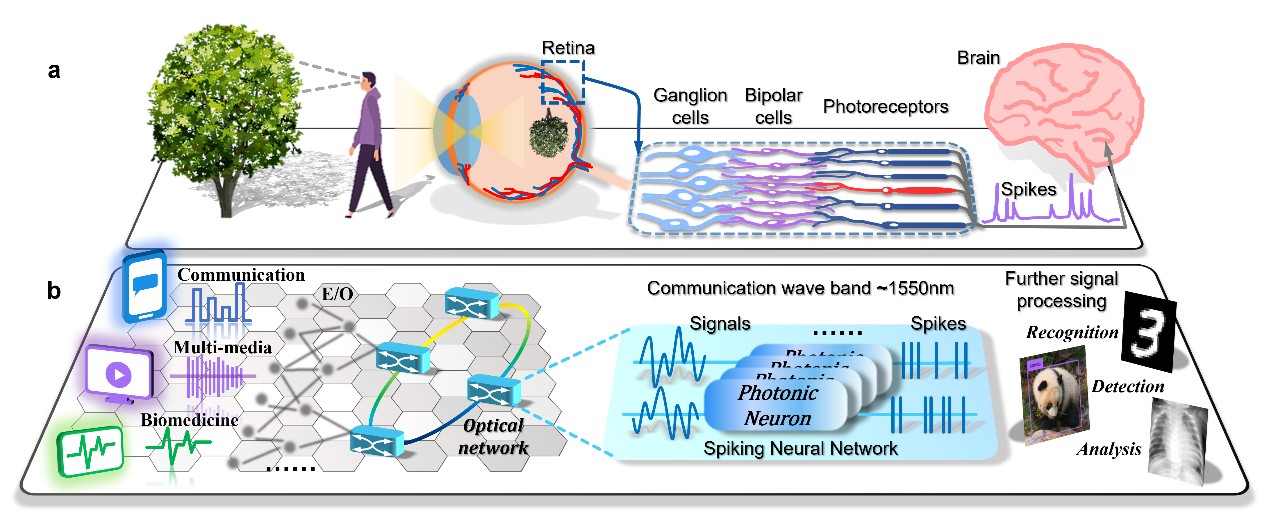
Schematic comparing biological neural network (top) and photonic spiking neural network (bottom). Real‑world signals from communication, multimedia, and biomedicine are converted into optical spikes for subsequent intelligent processing.
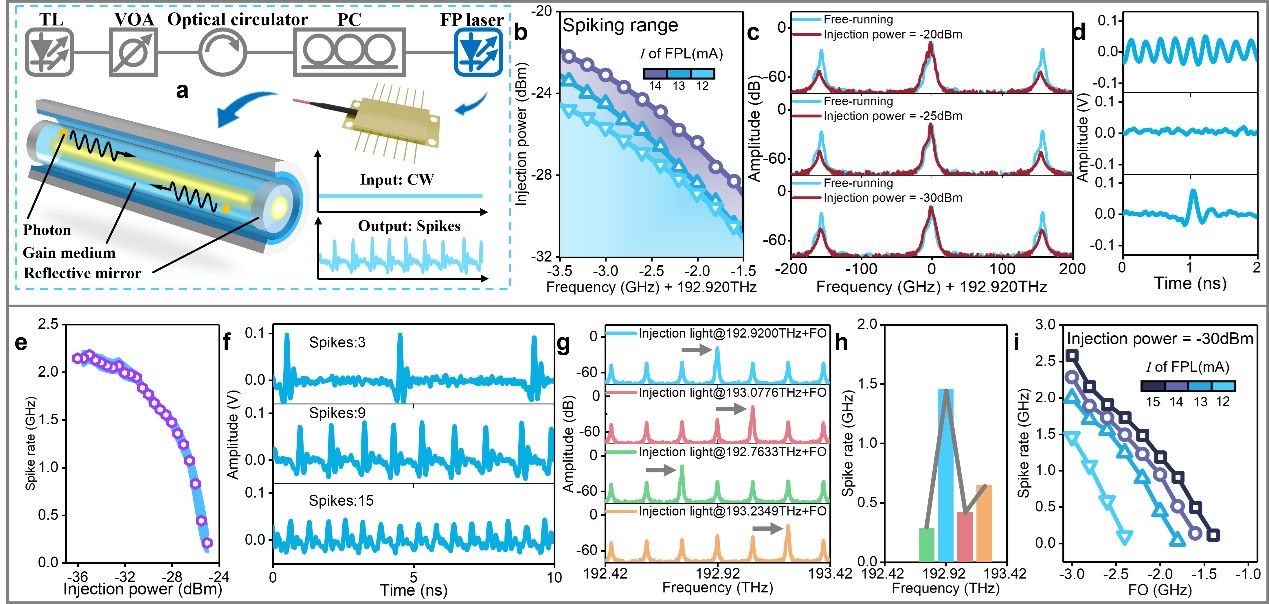
Experimental setup and measured characteristics of optical spikes generated from an optically injected Fabry–Perot laser neuron.
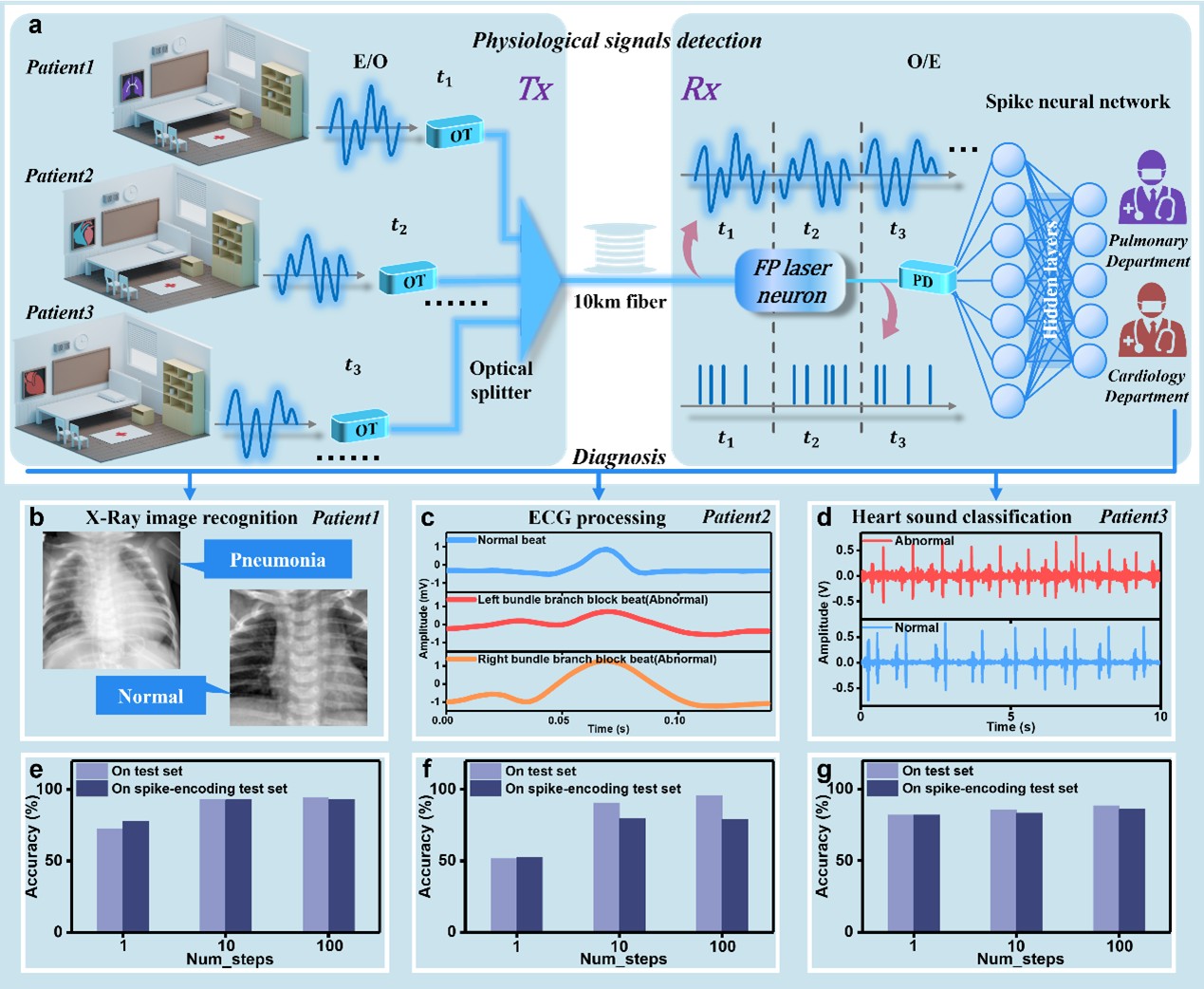
System architecture for remote physiological signal collection, fiber transmission, all‑optical spike encoding, and SNN‑aided medical diagnosis.
Laser‑based spike encoder bridges photonic hardware and intelligent medical diagnosis
CHINA, November 6, 2026 /EINPresswire.com/ -- Researchers develop an all‑optical biomimetic spike encoder using optically injected Fabry‑Perot laser neurons. It achieves > 2.0 GHz spike rate and ≈5‑bit linear encoding precision compatible with standard 1,550 nm fiber systems. Integrated with spiking neural networks, it enables image recognition and multi‑modal medical signal analysis, offering a low‑power pathway for large‑scale photonic neuromorphic applications.Brain‑inspired spiking neural networks (SNNs) process information via discrete spike pulses, promising low‑latency and energy‑saving artificial intelligence compared with conventional artificial neural networks. Nevertheless, real‑world deployment faces a major hurdle: how to efficiently convert real‑world analogue sensory signals into reliable optical spike sequences for photonic neuromorphic hardware.
Existing electrical spike generators are limited to low spike rates, unable to support high‑throughput computation. While earlier optical spiking devices can produce fast optical pulses, most only generate binary spikes without stable linear mapping between input signal strength and spike firing frequency. Few designs are built to work with existing fiber‑optic communication infrastructure, nor have they demonstrated end‑to‑end systems that handle diverse real‑life signals such as medical physiological data. There remains an urgent demand for high‑speed, precise, fiber‑compatible all‑optical spike encoders to move photonic neuromorphic computing from laboratory devices toward practical use.
The research group of Prof. Junwen Zhang and Prof. Nan Chi from Fudan University, China, and Prof. Jianyang Shi from Zhangjiang Laboratory, China, introduce an experimental all‑optical biomimetic spike encoder built upon optically injected Fabry–Perot (FP) laser neurons. The findings made available online on October 21, 2026, and published in Volume 5 of the Opto-Electronic Science journal on October 19, 2026.
Different from previous binary‑output photonic spiking devices, this setup builds steady monotonic correlation: stronger input optical intensity yields higher spike firing rate. By tuning injection power, laser frequency detuning and FP laser bias current, the team realizes amplitude‑to‑rate encoding with spike rates above 2.0 GHz and approximately 5‑bit encoding precision. Each spike consumes merely 0.5 pJ of energy, outperforming many competing electrical and optical solutions. Operating at the 1,550 nm telecommunication band, the encoder can directly work with widely deployed optical fiber networks.
When paired with digital spiking neural networks, the system reaches 94.1% classification accuracy for handwritten digit recognition on the MNIST dataset. Beyond static images, it translates continuous physiological and audio waveforms into ordered spike trains. The team further construct a scalable architecture supporting time‑division and wavelength‑division multiplexing. After transmission over 10 km single‑mode fiber, spike encoding performance stays robust. Proof‑of‑concept tests cover chest X‑ray screening, electrocardiogram arrhythmia identification, and heart‑sound classification for intelligent healthcare diagnosis.
This work reveals the laser dynamical mechanism behind amplitude‑rate encoding in injected FP lasers. It provides a feasible route to merge photonic spike encoders with existing fiber infrastructure for ultrafast, low‑power neuromorphic healthcare and communication applications.
***
Reference
Title of original paper: Ultrafast all-optical biomimetic encoder for spiking neural networks
Journal: Opto-Electronic Science
DOI: 10.29026/oes.2026.260051
About Professor Nan Chi from Fudan University
Prof. Nan Chi is a Professor at Fudan University, China. She received her bachelor's and PhD degrees in Electrical Engineering from Beijing University of Posts and Telecommunications. With over 25 years of research experience and more than 300 publications, her research focuses on optical fiber communication, coherent optical transmission, visible light communication, and optical switching. She is a recipient of the National Science Fund for Distinguished Young Scholars.
About Professor Junwen Zhang from Fudan University
Prof. Junwen Zhang is a Professor at Fudan University, China. He received his bachelor's degree from Huazhong University of Science and Technology and PhD from Fudan University. With over 11 years of research experience and more than 200 publications, his research focuses on high-speed optical transmission, optical interconnects, optical access networks, and photonic-wireless integration. He received the prestigious Marconi Young Scholar Award.
Siyi Ma
Institute of Optics and Electronics
oej_publishing@ioe.ac.cn
Legal Disclaimer:
EIN Presswire provides this news content "as is" without warranty of any kind. We do not accept any responsibility or liability for the accuracy, content, images, videos, licenses, completeness, legality, or reliability of the information contained in this article. If you have any complaints or copyright issues related to this article, kindly contact the author above.
